Reading the ISM tea leaves
Macro
Quick guide to interpreting the ISM
ISM
The Institute for Supply Management (ISM) produces two monthly reports, which serve as key gauges of the macro economy.
Diffusion
- Above 50: The reported measure increased from the prior month.
- Below 50: The reported measure decreased from the prior month.
- Equal to 50: No overall change.
Line Item Definitions
- PMI: Composite index summarizing the direction and breadth of month-to-month business conditions.
- Manufacturing PMI: Above 50 indicates manufacturing expansion; above 47.5 over time is associated with overall economic expansion.
- Services PMI: Above 50 indicates services expansion; above 48.1 over time is associated with overall economic expansion.
- Business Activity / Production: Change in current output or operating activity.
- New Orders: Change in new orders received from customers—a forward-looking indicator of demand.
- Employment: Change in firms’ employment levels.
- Supplier Deliveries: Speed of supplier deliveries; above 50 indicates slower deliveries.
- Inventories: Change in inventories held by respondents.
- Prices: Change in prices paid for intermediate inputs.
- Backlog of Orders: Change in orders received but not yet completed.
- New Export Orders: Change in new orders received from customers outside the United States.
- Imports: Change in respondents’ purchases of inputs from abroad.
- Inventory Sentiment: Respondents’ assessment of whether their inventories are too high or too low; above 50 indicates that inventories are viewed as too high.
Reading the August Reports
August 2026
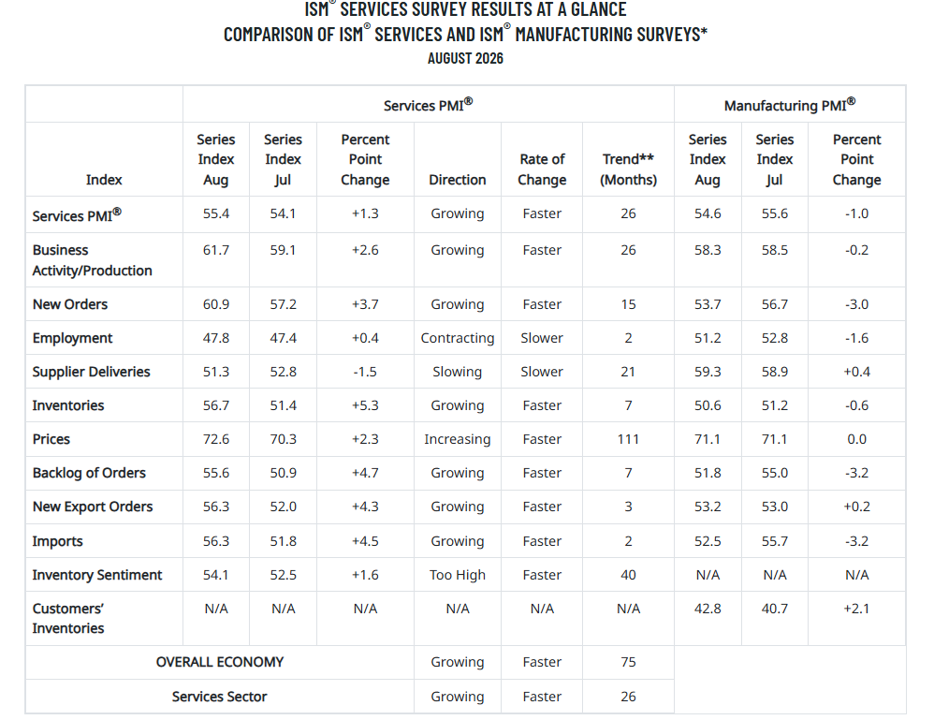
Here is the manufacturing report for Aug2026 and the services report for Aug2026
The services report comes out after the Mfg, and as such usually contains a nice snapshot table of both perspectives
TipQuestion
Compare new orders for Mfg and Services. Interpret.
NoteAnswer
- Services is 60.9 vs Mfg 53.7
- Both are above 50, and thus are both expanding.
- The higher services reading does not necessarily mean that the volume of services orders grew at a faster percentage rate.
- Rather, it indicates that the increase in new orders was somewhat more widespread among services respondents.
TipQuestion
Contrast the labor markets.
NoteAnswer
- Services employment is contracting
- Mfg employment is expanding, though at a slower pace.
TipQuestion
Describe pricing pressures in each sector. Use the table and commentary within the report.
NoteAnswer
- Both reports show Prices paid in the 70s, implying widespread increases in prices paid
- Both reports suggest shortages in prices related to tech (e.g. electrical components, GPUs, etc..)
- Interestingly, Mfg prices have slowed from 82, to 73, to 71. But that is NOT because more businesses are seeing prices falling, but rather fewer are seeing prices rising; i.e. stabilizing at a high level, not falling.